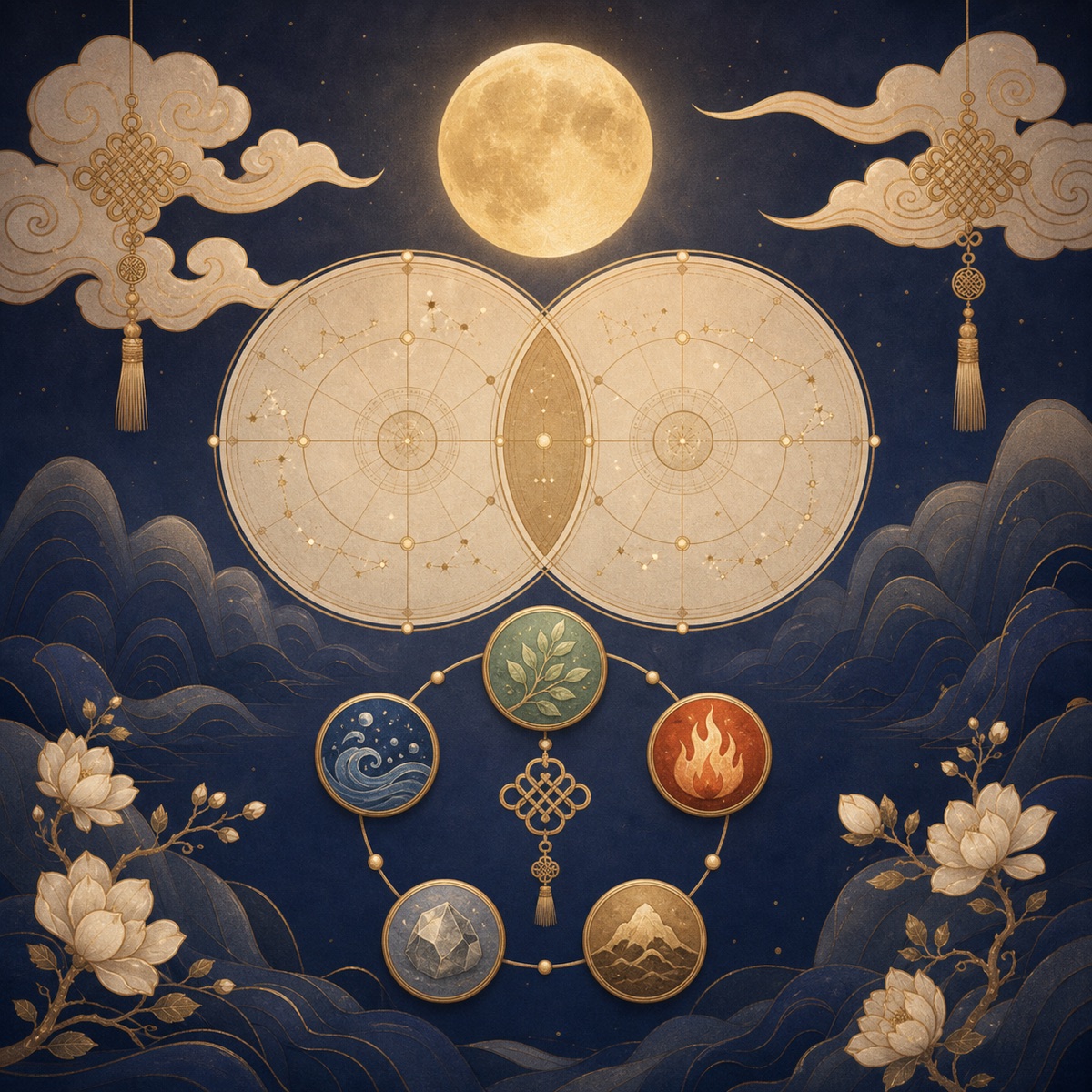
Should You Go Into Business Together? Decoding Your Business Partner Compatibility (재물 궁합)
Discover how Saju can reveal your business partner compatibility (재물 궁합), analyzing wealth, output, and elemental harmony for a successful venture.
Ever wondered why some business partnerships just *click*, leading to incredible success, while others feel like an uphill battle, full of misunderstandings and missed opportunities? It’s not always about having the best idea or the biggest budget. Sometimes, the secret ingredient is simply compatibility. And in the world of Saju, we have a special way to look at this for business ventures: 재물 궁합 (Jaemul Gunghap), or Business Partner Compatibility.
Think of it like this: your Saju chart is a blueprint of your unique energies and tendencies. When you combine your blueprint with someone else's, especially for something as significant as a business, those energies interact. Do they support each other? Do they clash? Do they create something even stronger together? That's what Jaemul Gunghap helps us understand – giving you insights into how you and a potential partner might fare in the entrepreneurial world.
What Exactly is Jaemul Gunghap (재물 궁합)?
At its heart, 재물 궁합 (Jaemul Gunghap) isn't just about whether you like someone. It's a deep dive into how your Saju charts align specifically for financial success and productivity in a business setting. The term itself combines "재물" (jaemul), meaning wealth or assets, and "궁합" (gunghap), which refers to compatibility. So, it literally means "wealth compatibility."
While traditional relationship compatibility often focuses on emotional connection and shared values, Jaemul Gunghap zeroes in on the practical aspects:
- Do your energies support generating wealth together?
- Are your working styles complementary or conflicting?
- Can you effectively produce results as a team?
It's about finding out if your combined "business DNA" is set up for synergy or struggle.
Beyond Friendship: Why Business Compatibility Matters So Much
You might be great friends with someone, enjoy spending time together, and even share similar life philosophies. But running a business together? That's a whole different ballgame. The pressures, responsibilities, and financial stakes can strain even the strongest personal bonds.
Here’s why looking at your 동업 궁합 (dong-eop gunghap) – another term for business partnership compatibility – through Saju is so insightful:
- Revealing Hidden Dynamics: Saju can uncover strengths and weaknesses that aren't immediately obvious. A partner might seem incredibly driven, but their chart could reveal a tendency towards impulsive decisions that clash with your more methodical approach.
- Strategic Role Assignment: Understanding each other's inherent tendencies (like who's better at initiating, who's better at nurturing, who's good with details, and who's a big-picture thinker) allows you to assign roles that play to your natural strengths, making the business more efficient.
- Conflict Prevention: Knowing where potential clashes might arise – perhaps one person naturally takes more risks while the other prefers stability – allows you to have proactive conversations and set clear boundaries or decision-making processes *before* problems escalate.
- Optimizing Wealth Generation: The core of Jaemul Gunghap is about assessing your combined potential for creating wealth. It looks at how your "wealth stars" and "output stars" interact, telling you if your combined efforts will multiply or dilute.
The Saju Secrets to Business Partner Compatibility: Wealth and Output Stars
When we analyze Jaemul Gunghap, our Saju engine specifically looks at two key areas within your charts: your Wealth Stars (재성, Jaeseong) and your Output Stars (식상, Siksang). Let's break down what these mean in plain English.
First, a quick refresher on your Day Master (일간, Ilgan). This is the Heavenly Stem (천간) of your Day Pillar (일주), and it represents *you* in your Saju chart. All other elements and "Ten Gods" (십성, Sip-seong) in your chart are interpreted in relation to your Day Master. If you're not sure what your Day Master is, no worries! Our Saju calculator can tell you right away.
Now, onto the stars:
1. Wealth Stars (재성, Jaeseong)
The Wealth Stars in Saju represent your relationship with money, assets, and resources. They show how you attract, manage, and interact with the material world. There are two types:
- 정재 (Jeongjae - Direct Wealth): This represents stable, predictable income, earned through consistent effort, hard work, and traditional means. Think salary, fixed assets, or reliable investments. People with strong Jeongjae tend to be good at budgeting and managing existing resources.
- 편재 (Pyeonjae - Indirect Wealth): This signifies wealth that comes from less conventional or more opportunistic sources, often through investments, speculation, or large-scale ventures. It can indicate a talent for seizing opportunities, taking calculated risks, and expanding wealth quickly.
In business compatibility, we look at:
- Do your combined Wealth Stars create a balanced approach? For example, a partner with strong Jeongjae might provide the stability and careful management needed for a venture, while a Pyeonjae partner brings the vision for growth and new opportunities.
- Is there enough "wealth energy" between you? If both partners have very weak or challenging Wealth Stars, it might indicate a struggle to accumulate or manage finances effectively together.
- Are your approaches to wealth conflicting? One partner might be a natural saver and cautious investor, while the other is a risk-taker. Understanding this helps you set clear financial strategies and boundaries.
2. Output Stars (식상, Siksang)
The Output Stars represent your ability to produce, create, express, and innovate. They are about how you put your energy out into the world and generate results. Like Wealth Stars, they also come in two forms:
- 식신 (Siksin - Eating God/Food God): This relates to steady, consistent output, often through craftsmanship, teaching, or providing services. It's about nurturing, creating value through dedicated effort, and enjoying the process. People with strong Siksin are often good at developing quality products or services.
- 상관 (Sanggwan - Hurting Officer): This signifies innovative, groundbreaking, and often rebellious output. It's about challenging the status quo, expressing unique ideas, and sometimes disrupting existing systems. People with strong Sanggwan are often brilliant at marketing, public speaking, and coming up with original solutions.
In business compatibility, we analyze:
- Do your combined Output Stars create a dynamic engine for the business? A Siksin partner might be excellent at developing the core product, while a Sanggwan partner excels at marketing and bringing it to the wider world.
- Is there sufficient creative and productive energy? If both partners lack strong Output Stars, there might be challenges in generating new ideas, taking initiative, or effectively promoting the business.
- Do your output styles complement each other? One partner might be methodical and patient, while the other is quick-witted and eager for immediate results. Understanding these differences can help you divide responsibilities effectively.
The Role of the Five Elements (오행, Ohaeng) in Balancing Your Business
Beyond the specific Ten Gods, Jaemul Gunghap also heavily considers the Five Elements (오행, Ohaeng): Wood (목), Fire (화), Earth (토), Metal (금), and Water (수). Each element has specific qualities and interacts with others in either a productive (상생, Sangsaeng) or controlling (상극, Sanggeuk) cycle.
Our Saju engine specifically examines the elemental balance and interactions between your two charts:
- Elemental Complementation (오행 보완, Ohaeng Bowan): This is ideal! If one partner's chart is strong in Wood but weak in Fire, and the other partner's chart has abundant Fire, they naturally complement each each other. This creates a more balanced and harmonious energy flow for the business. It’s like having someone who's great at planning (Wood) and someone who's great at execution and passion (Fire) – they feed each other's success.
- Elemental Clashes (오행 충돌, Ohaeng Chungdol): These are areas where the elements in your charts might conflict. For example, if both partners have an overwhelming amount of Fire, it could lead to impulsive decisions, burnout, or intense arguments. Or, if one partner's dominant element strongly controls the other's key elements, it might create an imbalance of power or constant friction.
Understanding these elemental interactions can highlight where you might naturally support each other, and where you might need to consciously work on communication and compromise to prevent friction.
Ready to Explore Your Business Partnership Potential?
Deciding to go into business with someone is a huge step, and having insights into your 재물 궁합 (Jaemul Gunghap) can be an invaluable tool. It’s not about predicting a fixed outcome, but rather about understanding the energetic tendencies and dynamics at play. This knowledge empowers you to:
- Choose partners wisely: Identify individuals whose Saju charts naturally complement yours for business success.
- Strengthen existing partnerships: Understand areas for growth and develop strategies to overcome potential challenges.
- Optimize roles and responsibilities: Leverage each other's natural strengths for maximum efficiency and wealth generation.
Our Saju engine is designed to quickly analyze these intricate relationships between your charts, providing you with clear, actionable insights into your business partner compatibility. Give your entrepreneurial journey the best possible start by understanding the hidden energies at play.
Ready to uncover your business compatibility? Calculate your Business Partner Compatibility now!